A new leather wallet is a uniform colour. Six months later it is not. The edges are darker, the fold has a soft sheen, and the surface has taken on the shape of the pocket it lives in. That change is patina, and it is the difference between leather and a material that only looks like it.
What is happening
Leather is a network of collagen fibres, tanned and finished but still porous. Oils from your hands, friction, sunlight and time all move through that network. The fibres compress where the piece flexes, the surface takes on a polish, and the colour deepens. The process is uneven because use is uneven. The corner that rubs against a key marks first.
Patina is not wear. It is evidence.
Why some leather patinas and some does not
A heavily coated, corrected hide has a plastic surface that resists oil and friction. It stays uniform, which is the point of buying it. A full-grain, vegetable-tanned or lightly oiled hide absorbs and changes. The same hide finished with a heavy lacquer will stay closer to its original colour, so the finish decides as much as the tannage.
Colour matters too. Natural, tan and brown hides show the change most clearly. Black leather patinas into a deep shine rather than a new colour. Both are worth having; they simply record use differently.
How to encourage it, gently
- Use the piece. Carry it daily. Patina comes from use, not from a bottle.
- Keep it clean. Dust and grit abrade the surface; a dry cloth is enough.
- Condition sparingly. A little neutral cream once or twice a year supports the leather without flooding it.
- Keep it out of direct sun and away from radiators. Heat ages leather faster than handling.
- Do not try to make the patina even. It will not be, and an even patina is a contradiction.
When patina becomes damage
There is a line between character and deterioration. Cracking, flaking, a torn seam or a stretched-out shape are not patina. They are signs that the piece has been over-oiled, over-dried or overloaded. A good repairer can often fix them, but the earlier the better.
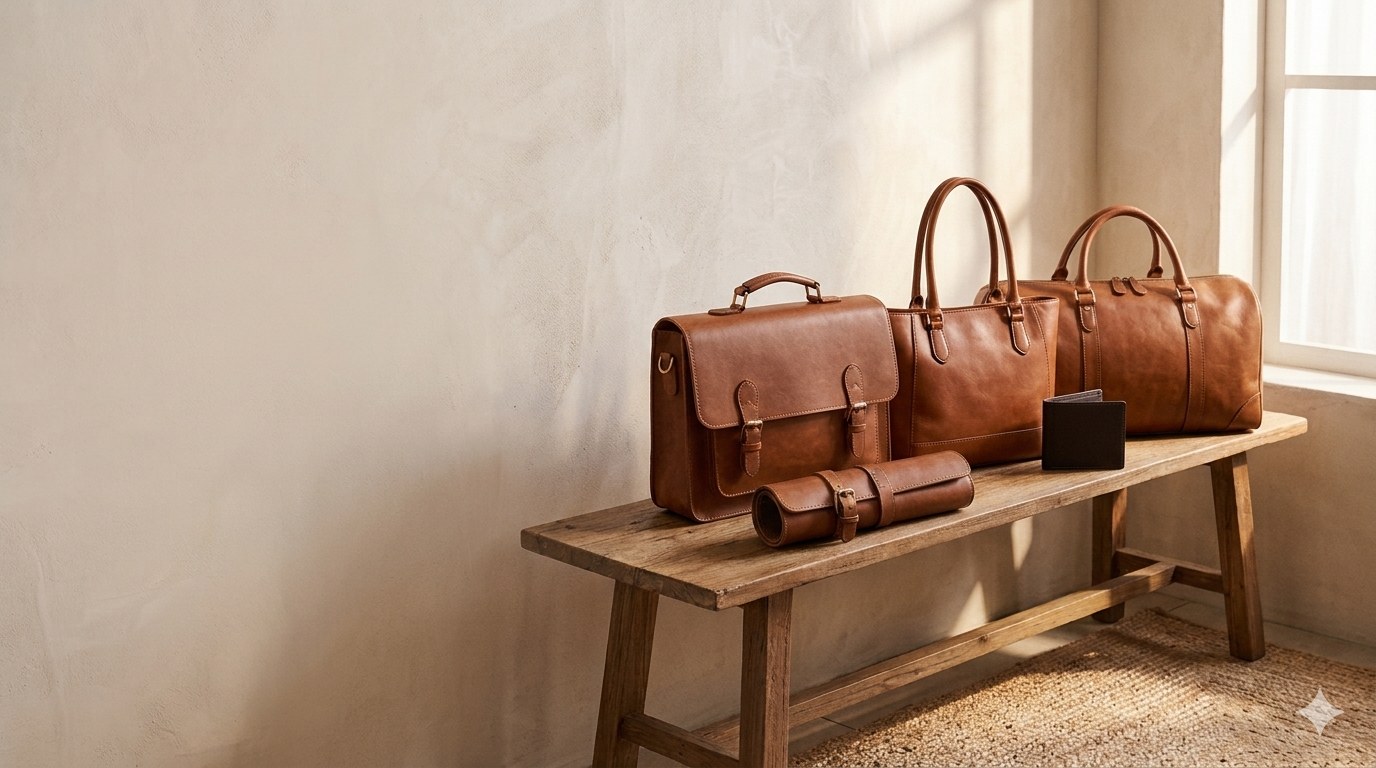
A piece that changes is a piece that is being used. That is the point of buying it. The uniform surface in the photograph is not the finished object; it is the starting point.
Full-grain pieces, cut and finished in small runs.